
Getting your curtains measured right starts with choosing your style—pick a header type like eyelet or pencil pleat that fits your room’s vibe.
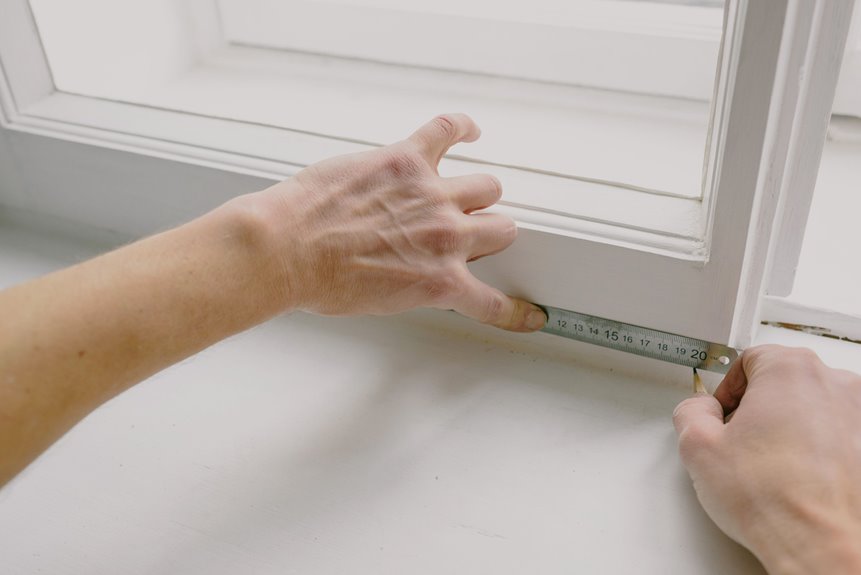
Gather tools: metal tape, stepladder, and level.
Measure width and height based on whether you’re mounting inside or outside your window frame.
Calculate panel width by multiplying your rod width by your fullness multiplier (1.5x to 2.5x).
Finally, pick your length—sill, floor, or pooled.
Follow these five steps, and you’ll achieve properly fitted curtains.
Choose Your Curtain Style: Header Type and Fullness
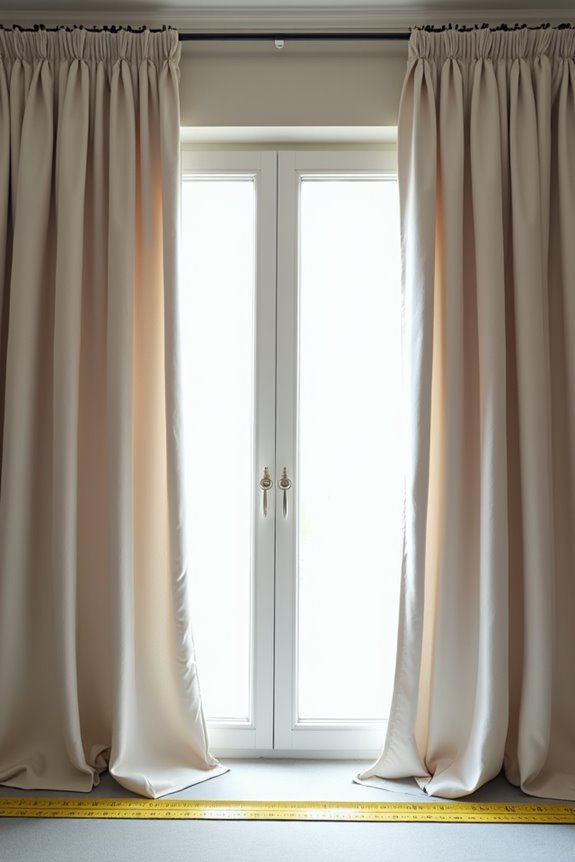
How do you want your curtains to look when they’re hanging on your window—sleek and simple, or dramatically full and luxurious?
Your header type sets the tone. Readymade curtains offer eyelet, pencil pleat, tab top, and slot top options. Each creates a different vibe, so pick what matches your space.
Your header type sets the tone—eyelet, pencil pleat, tab top, or slot top each create a different vibe for your space.
Next, consider curtain fullness. Multiply your window width by 1.5x for standard fullness or 2x for a fuller look. Want that luxury effect? Go 2.5x. Heavier fabrics look best with generous fullness, while lighter ones work at 1.5x.
Your mount choice matters too. Inside mount curtains match your window width exactly. Outside mount curtains need the rod extending 6–12 inches beyond the frame on each side, giving you more visual width and light control.
Balance practicality with your desired aesthetic, and you’ll get the results you want.
Prepare to Measure: Tools and Rod Placement
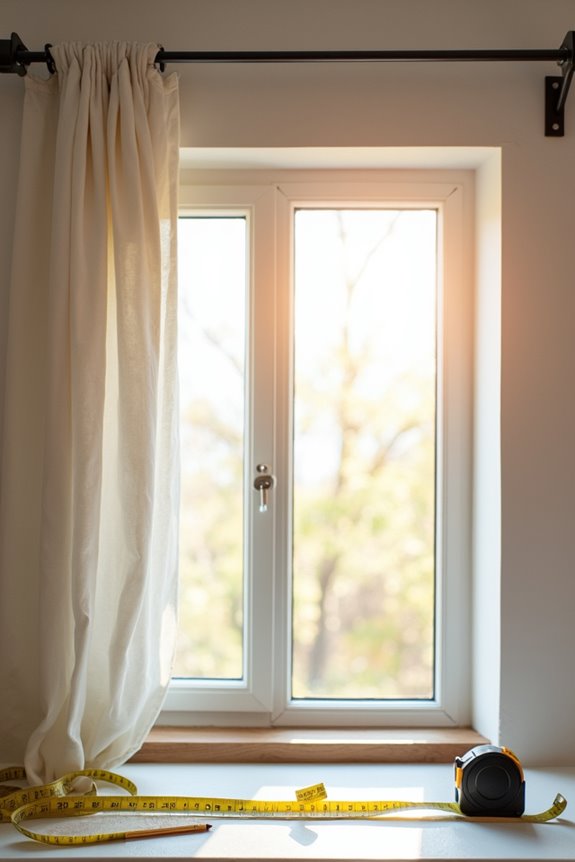
Once you’ve decided on your header type and fullness, it’s time to gather your tools and figure out where your rod will actually go. Grab a metal measuring tape for accuracy, rounding to the nearest 1/8 inch. You’ll also need a stepladder tall enough to reach your curtain rod area, a pencil for marking, and a level—this last one’s important for keeping everything even.
Before measuring, decide whether you want inside-mount or outside-mount installation. Inside-mount means measuring from your trim reference points inside the window frame. Outside-mount lets you measure beyond the frame entirely. This choice determines your window width and window height measurements, affecting your full length curtains.
Have your rod placement plan ready. Proper positioning influences everything that follows.
Measure Width and Height for Your Mount Type
Measure Width and Height for Your Mount Type
The measurements are what matter most—and you’ve already made the hardest decision by choosing your mount type.
For Inside Mounts:
Measure your window width including the casing or molding. Add at least 4 cm on each side for fullness, so your curtains drape well. Your curtain rod width equals this total measurement.
For Outside Mounts:
Measure from outside the trim, left-to-right and top-to-bottom. Your rod should extend 6–12 inches beyond the window frame on each side for a polished appearance.
For Length:
Measure from your rod down to your chosen endpoint—sill, floor, or somewhere between. Want extra fabric to puddle or break? Just add 0.25–6 inches more.
Calculate Curtain Panels: Width and Fullness Explained

Now that you’ve got your rod width measured, it’s time to figure out how much fabric you actually need for each panel. You’ll multiply your rod width by a fullness multiplier to get your total panel width. This choice affects how your curtains look.
| Fullness Level | Multiplier | Best For | Window Width | Panel Width |
|---|---|---|---|---|
| Standard | 2x | Budget-conscious applications | 40″ | 80″ |
| Luxury | 2.5x | Fuller appearance | 40″ | 100″ |
| Inside Mount | 1.5x | Compact spaces | 36″ | 54″ |
| Outside Mount | 2x | Maximum coverage | 40″ | 80″ |
| Thin Fabrics | 2.5-3x | Sheer options | 40″ | 100-120″ |
Double fullness creates a polished look, while 2.5x gives you that rich drape. Ready-made pairs work well for standard applications.
Determine Your Length: Sill, Floor, or Puddle
Want drama? Puddle length adds 3–6 inches of luxurious fabric beyond the floor—ideal for taller ceilings. Each curtain measurement choice shapes your room’s personality. Pick what matches your space’s needs and your ceiling height.